Waddington welcomes second Protector
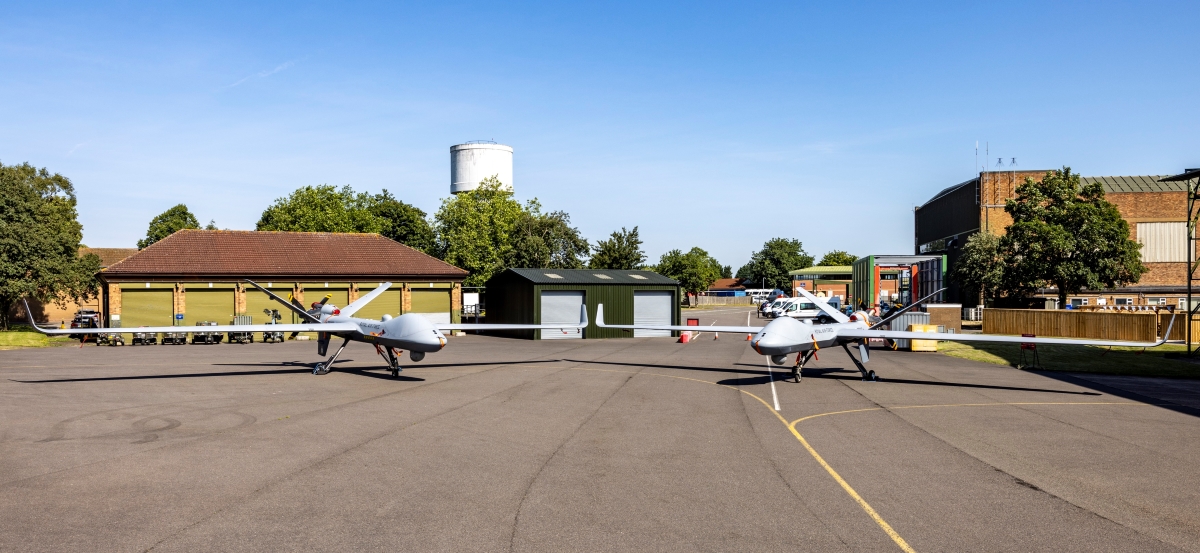
Image courtesy General Atomics
The second Protector has started its ground trial at RAF Station Waddington with first flight expected next month. Protector is based on the MQ-9B SkyGuardian RPA developed by General Atomics Aeronautical Systems, Inc. (GA-ASI) and is specially configured for the RAF.
The RAF has taken delivery of 10 of their total order of 16 Protectors from GA-ASI, with eight aircraft currently undergoing RAF crew training, test and evaluation in the United States.

“We’re thrilled to see a second Protector operating at Waddington,” said Chris Dusseault, GA-ASI’s vice president of MQ-9B in Europe. “The Royal Air Force is a great partner for GA-ASI and we look forward to additional MQ-9B aircraft operating in the UK and more broadly across Europe.”
Simon Holford, Uncrewed Air Systems Delivery Team Leader at Defence Equipment & Support, said: “Seeing delivery and assembly of the second Protector aircraft in the UK is yet another measure of the significant progress on this project and testament to the hard work of everyone involved. Together with the three aircraft we have already taken delivery of in the US (which remain in the US for use in trials and/or training), we have now taken delivery of five of the 16 aircraft we have ordered.”
Officer Commanding 31 Sqn, Wing Commander Maccoll, said: “I’m delighted to see another RAF Protector assembled at RAF Waddington, thanks to the hard work of our Programme team, Defence partners, contractors and the skill of 31 Squadron personnel. This summer, Protector will undertake further test and evaluation and we expect more aircraft arrivals before the end of the year.“
In another programme milestone, the first of four cadres of RAF aircrew completed training on 29th April 2024, at GA-ASI’s Flight Test and Training Center (FTTC) in Grand Forks, North Dakota. The GA-ASI training involved RAF Operational Conversion Units (OCUs), which are comprised of eight crews, including pilots, sensor operators (SOs) and mission intelligence coordinators (MICs) from 31, 54 or 56 Squadrons.
The scope of the training is focused on foundational skills required to operate the Protector air vehicle and its equipment, including the Multi-Spectral Targeting System (MTS), Synthetic Aperture Radar (SAR), Mission Intelligence Station (MIS) and System for Tasking and Real-Time Exploitation (STARE). Training involves building solid foundations for both normal and emergency operations in Intelligence, Surveillance and Reconnaissance (ISR) systems, instrument flying and Automatic Takeoff and Landing Capability (ATLC).
With the completion of the Protector Technicians course at GA-ASI facilities in Southern California on 16th May 2024, Number 31 Squadron now has another 21 qualified maintainers. As part of their training course, the RAF maintainers were able to directly support the training flights for their aircrew counterparts who were completing the live flying element of their Operational Conversion course from North Dakota.
MQ-9B is GA-ASI’s next-generation RPA System (RPAS), delivering exceptionally long endurance and range, with auto takeoff and landing under SATCOM-only control and will be able to operate in unsegregated airspace using the GA-ASI-developed Detect and Avoid system. In addition to the RAF, contracts have been signed with Belgium, Canada, Taiwan and the US Air Force in support of the Special Operations Command.
The Japan Coast Guard is currently operating the MQ-9B for maritime operations, which the Japan Maritime Self-Defense Force (JMSDF) also selected for its Medium-Altitude, Long-Endurance (MALE) Remotely Piloted Aircraft System Trial Operation Project. MQ-9B has additionally supported various US Navy exercises, including Northern Edge, Integrated Battle Problem and Group Sail.