Astroscale to continue UK national debris removal mission
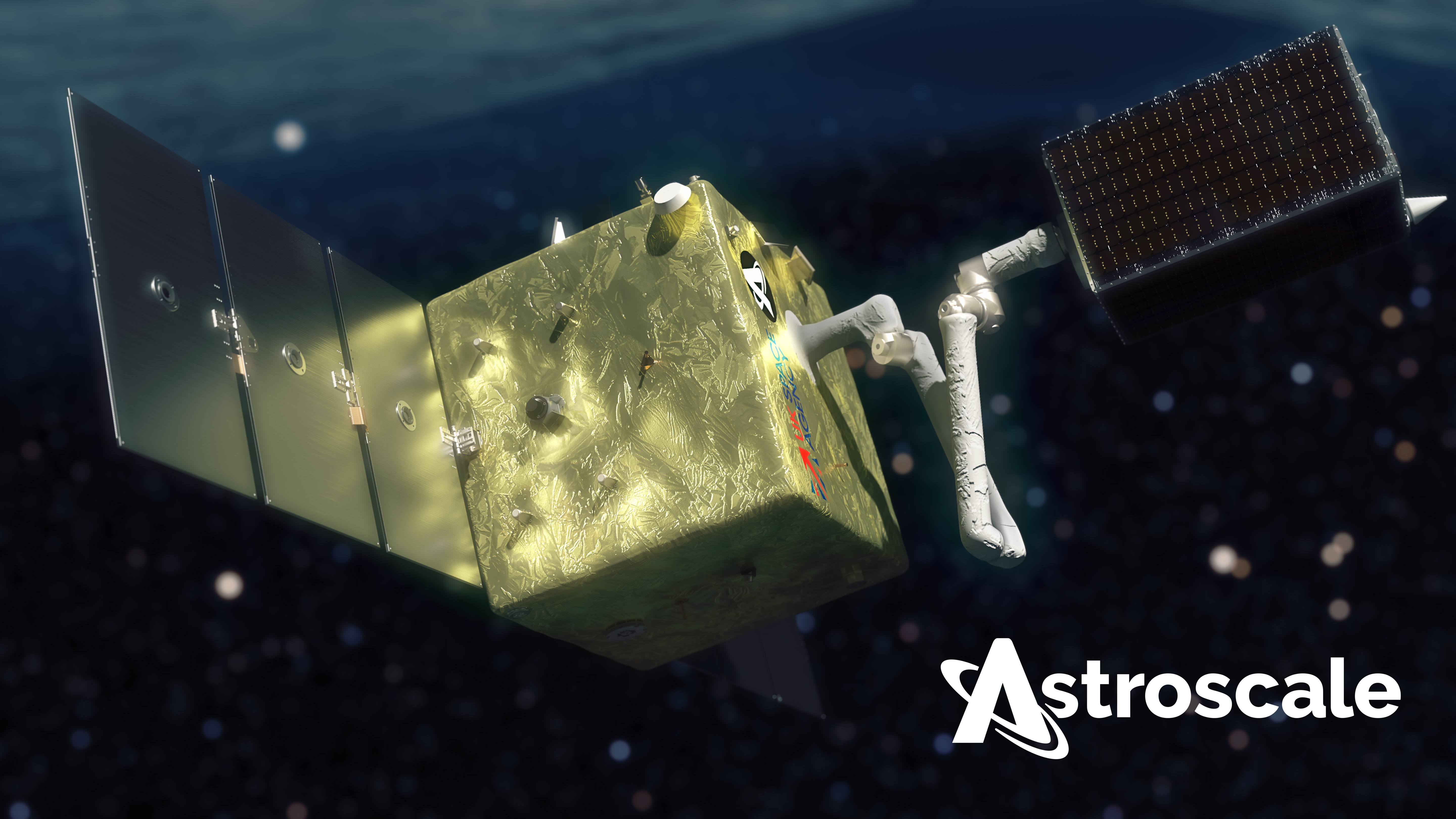
Above: Close-up image of Astroscale UK ADR servicer COSMIC with captured client satellite.
Copyright Astroscale
COSMIC is Astroscale’s solution for a UK national active debris removal (ADR) mission to remove two inactive British satellites from space.
This next mission phase will focus on maturing and de-risking key technologies identified in the previous UK ADR phases, such as the robotic capture system and debris detumbling capabilities. By leveraging significant flight heritage in rendezvous and proximity operations from Astroscale’s current missions, COSMIC will ensure delivery of an assured, safe and highly reliable UK ADR capability.

“We’re delighted to have been awarded this UK Space Agency contract to progress the further development of a UK ADR mission towards implementation,” said Nick Shave, Managing Director of Astroscale UK. “Our UK ADR mission design ensures a low-risk approach because it is based on flight-proven heritage from Astroscale missions in-orbit now such as ELSA-d and ADRAS-J, plus many mission elements from our UK-focused industrial supply chain with flight heritage.”
“The global space industry continues to set new records for the number of satellites launched into orbit, with more than 2,780 launched in 2023 alone,” said Paul Bate, CEO of the UK Space Agency. “While these satellites deliver valuable services back to people on Earth, we also need to make sure we protect the space environment and develop new ways to remove space debris. That’s why this next phase of work towards a national ADR mission is so important. We want to build on the successful completion of the preliminary mission designs, and support Astroscale and their partners as they continue to develop and derisk this innovative technology.”
Astroscale UK’s bid for the contract incorporates experienced, UK and European industrial leaders in advanced space systems, including: Airbus Defence and Space UK, MDA UK, Nammo UK, Thales Alenia Space UK, GMV UK, AVS UK, D-Orbit UK, Redwire, DLR and Clyde&Co.
Astroscale UK will also continue to collaborate with several other companies spread across England, Scotland and Northern Ireland, for the development of the COSMIC servicer, leveraging the growing Astroscale UK supply chain consisting of nearly 100 companies. COSMIC will be developed, built and operated from Astroscale’s Zeus facility in the UK. The supply chain for in-orbit servicing will also strongly support the creation and sustainment of highly skilled jobs and enhanced collaboration with space clusters across the UK.
The COSMIC debris removal servicer will be a technological evolution of Astroscale’s End-of-Life Services by Astroscale-Multi-client (ELSA-M) servicer. In July 2024, Astroscale UK announced the signing of a contract with Eutelsat OneWeb for the final phase of the ELSA-M in-orbit demonstration as part of the Sunrise Partnership Project between the European Space Agency (ESA) and Eutelsat Group with support from the UK Space Agency. The groundbreaking ELSA-M mission, which will be the world’s first commercial end-of-life service for prepared satellites, is set to launch in the fiscal year ending in April 2026 ahead of the COSMIC mission.
Since its launch in February 2024, the Active Debris Removal by Astroscale-Japan (ADRAS-J) mission led by Astroscale Japan for the Japan Aerospace Exploration Agency’s Commercial Removal of Debris Demonstration (CRD2) program has accomplished several major mission milestones, including the successful safe and controlled approach and fly-around operations of an unprepared Japanese upper stage rocket body while maintaining a controlled fixed-point relative position of approximately 50 metres from the upper stage. Astroscale Japan has also been selected for Phase II of the CRD2 programme, in which the servicer will remove and deorbit the upper stage.